
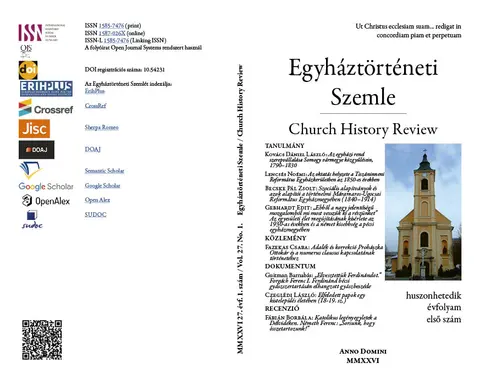
Social foundations and their founders in the historical Reformed Diocese of Máramaros-Ugocsa (1840–1914)
DOI:
https://doi.org/10.54231/ETSZEMLE.27.2026.1.3Keywords:
founders, parish, Reformed Church, Reformed Diocese of Máramaros-Ugocsa, social foundations, social traitsAbstract
Numerous scientific publications have already appeared in Hungarian historical literature on foundations in the 19th and 20th centuries. However, the social and economic historical analysis of the foundations emerging in the historical Reformed Diocese of Máramaros-Ugocsa has not yet been addressed. In this study, I aim to present the main traits of social foundations established between 1840 and 1914, as well as the social composition of their founders. Based on the accessible data, at least 28 social foundations were established in the 18 parishes of the diocese during the researched period. In the first part of the study, I examine the distribution of the founding years and foundation goals, the origin, size, and form of their capital. Following this, I analyze the social traits of the founders (residence, social origin, occupation, gender, age, etc.).
Downloads
Downloads
Published
Conference Proceedings Volume
Section
Categories
License
Copyright (c) 2026 Becske Pál Zsolt (Szerző)

This work is licensed under a Creative Commons Attribution 4.0 International License.
The author(s) reserve the copyright of their work.
The Church History Review does not restrict the rights of authors to place their manuscripts or manuscript versions on preprint servers or other hosting. This applies generally to the following formats.
- Submitted version
- Accepted version (manuscript accepted by the author)
- Published version (Version of Record)