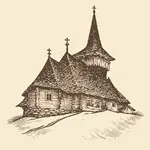
"...the most precious and the best congregation in the world for me is that of the gypsies of Karácsonfalva"
Considerations for the study of the new religious identity of the Gabor Gypsies
DOI:
https://doi.org/10.54231/ETSZEMLE.2023.4.161Keywords:
Gabor Gypsies, Adventism, religious–social inversion, (re)socializationAbstract
In my paper, through semi-structured interviews, I analyze the social relations surrounding Adventist religious life, as well as its cultural representativeness, and I put it in the context of Gypsy-Hungarian, Gypsy-Gypsy, and Hungarian-Gypsy social relations in Nyárádkarácsonfalva (Mures County, Romania). Within the local community, the Adventist denomination of the Gabor Gypsies, and the physical boundaries of their religious life, have created a transethnic community (the number of Hungarian converts to the Adventist Church has been increasing recently). Regulated norms of behavior and determined opportunities for encounters are being expanded, and eradicated. However, the process is not even, because despite the emergence of a transethnic–religious ideolog y in social relations, the distancing on the mental/symbolic plane is still permeated with prejudice. At times, the Hungarian community still stigmatizes the Gabor Gypsy community by reconciling adverse ethnic discrimination with the negative perception of ‘sectarianism’, the ‘Sabbatarianism’ of the free church membership. Complementarity emerges in everyday encounters, despite ethnic dis-tance and conscious physical demarcations. The anthropological research on religious conversion best demonstrates, in contrast to the principle of discontinuity, that in religious conversion the importance of previous values is not diminished but replaced by something (new). For example, the continuity of Gypsy identity is preserved (as in the case of the community under study), but a new system of translocal relations is created. The conversion to Adventism as a model of (re)socialization in the case of the Gabor Gypsy community of Nyárádkarácsonfalva is demonstrated in the interaction of social–religious changes. This interaction has rationalized (and importantly, has not modernized!) interethnic relations.
Downloads
Downloads
Published
Conference Proceedings Volume
Section
Categories
License

This work is licensed under a Creative Commons Attribution 4.0 International License.
The author(s) reserve the copyright of their work.
The Church History Review does not restrict the rights of authors to place their manuscripts or manuscript versions on preprint servers or other hosting. This applies generally to the following formats.
- Submitted version
- Accepted version (manuscript accepted by the author)
- Published version (Version of Record)