
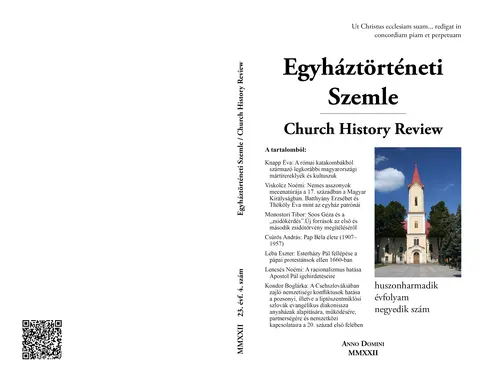
The impact of the ethnic conflicts in Czechoslovakia on the foundation, operation, partnership and international relations of the Slovakian Lutheran deaconess motherhouses in Bratislava and Liptószentmiklós in the first half of the 20th century
DOI:
https://doi.org/10.54231/ETSZEMLE.2022.4.7Keywords:
deaconess, Lutheran, Slovak, Czechoslovakia, charityAbstract
The first Slovak-speaking Lutheran deaconess motherhouse in
Liptószentmiklós began its charitable service in 1935 in Czechoslovakia, and later in Slovakia, which was independent from 1939 to 1945. The independence of the institution in Liptószentmiklós from the deaconess institute in Bratislava was strongly influenced by the Slovak nationalist aspirations that were evolving at the time. The study briefly analyses the impact of the autonomy movement, examines the operation of the deaconess motherhouse in Liptószentmiklós from its foundation until its nationalisation in the 1950s, and describes the institution’s relations with domestic and international charities and motherhouses.
Downloads
Downloads
Published
Conference Proceedings Volume
Section
Categories
License

This work is licensed under a Creative Commons Attribution 4.0 International License.
The author(s) reserve the copyright of their work.
The Church History Review does not restrict the rights of authors to place their manuscripts or manuscript versions on preprint servers or other hosting. This applies generally to the following formats.
- Submitted version
- Accepted version (manuscript accepted by the author)
- Published version (Version of Record)