
Methodological Guidelines for Online References
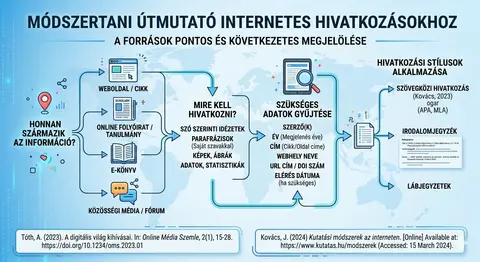
Introduction
More than a quarter of a century has passed since the World Wide Web became an integral part of scientific research and publishing. It is now 2026, yet experience shows that the culture of citing digital sources has not kept pace with technological advancements. Erroneous or non-functional, purely technical citations (URL graveyards) are common in various scientific journals and volumes, failing to meet the fundamental requirements of scientific methodology. Digital content does not exempt one from bibliographic discipline. Below, we summarize in plain and clear language the rules that are essential for the creation of authentic, retrievable, and aesthetically pleasing scholarly texts.
Important: This guide focuses on methodological issues regarding the handling of digital sources and is compatible with any citation style (MLA, APA, Chicago, ITK, Hungarian Language Style Guide, etc.). The formatting of the examples shown is for illustrative purposes only—the specific formatting of bibliographic entries (font, punctuation, etc.) must be done according to the citation standard you are using. The guiding principles of this manual—the primacy of metadata, the proper role of links, and the judicious use of download dates—apply to all standards.
I. BASIC PRINCIPLES
1. A link is not a citation, but merely a location. Providing a standalone URL is a serious methodological error. This is equivalent to citing only the library call number for a book instead of the author and title. The link (URL) is merely a technical aid; it does not replace the bibliographic data of the work.
Example of incorrect practice:
https://mek.oszk.hu/09400/09477/html/0019/1729.html
What does this not tell us?
• Who is the author?
• What is the title of the work?
• When was it published?
• In what context do we find it?
2. The primacy of bibliographic metadata: the following must be included for every online source:
• Author (if not named, the name of the institution)
• Title (the title of the work, not the website’s!)
• Publication platform (name of the journal, database, or portal)
• Publication date (if known)
Identifying the content is primary; accessibility is secondary.
3. Debunking the “Download Date” Myth
In scholarly texts, we generally cite stable, verified sources. The mechanical use of the download date is misleading and places an unnecessary burden on bibliographies.
When a download date is NOT required:
• Digitized printed works (books, old journals) – the content does not change
• Published scientific articles, studies – the publication date is the relevant one
• Official documents available on archiving platforms
When a download date is REQUIRED:
• Live statistical databases (data updated daily)
• Social media posts (can be deleted or modified)
• Dynamically generated content (e.g., real-time maps, prices)
• Any website whose content changes from day to day
The right question: Could this content change by tomorrow? If not, the download date is irrelevant.
II. TECHNICAL GUIDE
1. The problem with long links and the “Homepage Principle”
Deep links appearing in printed text—consisting of three or four lines of random characters—are aesthetically unacceptable, impossible to type out, and have a short lifespan (link rot) .
• Recommendation: If the source is part of a well-structured, searchable database (e.g., Hungaricana, Arcanum, MEK), provide the service provider’s homepage instead of the long URL, supplemented with the exact navigation path.
• Advantage: The homepage address remains permanent, while dynamically generated internal links often become obsolete.
• Exception: If it is (or appears to be) difficult to find the document via search on the database’s homepage (e.g., genealogical databases such as FamilySearch), then a direct link to the document’s description page—stripped of settings and other unnecessary parameters—may be provided, but the full bibliographic description is still required in this case.
2. Digitized versions of physical documents
Order is crucial. If we are referencing a 19th-century charter collection or a 1940s reference book, the primary source is the physical work.
Correct procedure:
1. Provide the complete bibliographic description of the physical work (Author, Title, Place of Publication, Publisher, Year)
2. Following this, as an optional addition: “Online: [Database Name/Homepage]”
3. If useful, specify the specific chapter, page, or document number
Rationale: The digitized version is a secondary form of publication of the physical work. The primary purpose of an academic citation is to identify the work, not to locate the digital copy.
3. DOI – The guarantee of digital permanence
For contemporary studies, if the work has a DOI (Digital Object Identifier), its use is mandatory. The DOI is the only guarantee of long-term accessibility.
Important: When using a DOI, providing any other URL or homepage is unnecessary and confusing.
Why?
• The DOI is a standardized, international identifier
• It ensures redirection if the content is moved to a new location
• It is not as fragile as traditional URLs
4. Non-textual documents
For images, maps, audiovisual materials, and databases, the description of the content is also the primary focus.
Required elements:
• Creator/Institution
• Title/Subject
• Date (creation or publication)
• Location (URL) – in accordance with the above principles
Example: Photograph of József Bem, circa 1848. Hungarian National Museum, Historical Photo Archive, inv. no. 1234/56. Online: https://mnm.hu
Copyright Compliance
When publishing or using images, illustrations, maps, or other visual content, it is mandatory to verify the legality of their use. A mere reference does not automatically grant the right to publish!
Checking license information:
• Check the license information on the website where the image is published. Many institutions (museums, archives, digital collections) clearly state the terms of use. If there is no clear license information: You must request written permission for use from the image’s owner or rights holder.
• Public Domain: This term clearly indicates that the image in question may be used freely, without restrictions. In Hungary, a work generally enters the public domain 70 years after the author’s death.
• Creative Commons (CC) licenses: These indicate images that may be used freely, but with conditions. The most common license types:
CC BY – Free use, but attribution is required
CC BY-SA – Free use with attribution + the resulting work may only be distributed under the same license
CC BY-NC – Non-commercial use only + attribution
CC BY-ND – No modifications allowed + attribution
Indicating the license in the citation:
If the image is licensed under CC or another license, this must be indicated in the bibliographic entry:
Example:
Aerial view of Esztergom. Photo: János Nagy, 2020. Wikimedia Commons. License: CC BY-SA 4.0. https://commons.wikimedia.org
Fair use rules vary by country and depending on the purpose of use. Even when using images in academic publications, it is recommended to obtain permission from the copyright holder or to use public domain or freely licensed images.
5. Web Archiving: A Solution to the Problem of Link Rot
The biggest problem with digital references is that URLs die—servers go down, pages are restructured, and content is deleted.
• Solution: If you link to a page that does not have a DOI and is at risk of being taken down (e.g., a blog post, an article on a small news site), use the Internet Archive (Wayback Machine) or the Perma.cc service.
• Advantage: Instead of the original link, we provide an archived version, so even decades from now, the reader will likely see exactly what the author saw.
Example of a correct citation:
Péter Kiss: Title of blog post. Jan. 15, 2024. Archived version: https://web.archive.org/web/20240115120000/https://example.com/cikk
6. URL shorteners and their risks
Bit.ly, tinyurl.com, and similar services should be avoided in academic citations. If the service provider goes out of business, the link will be lost.
Recommended alternatives:
• DOI (if available)
• Handle system (for university repositories: hdl.handle.net/...)
• Home page + search guide
7. PDF references
A common mistake is to link directly to a PDF file (.../document.pdf).
Why is this bad?
• System administrators often rename the file
• A direct file link is fragile
Correct: Always link to the landing page from which the PDF can be downloaded.
8. Social media and dynamic content
For social media posts (Twitter/X, Facebook, Instagram, etc.):
Required elements:
• Author (username)
• A brief description or the first sentence of the post
• Platform name
• Exact date and time
• URL
• Date of download/view (since the post may be deleted)
Even better: Use an archived version (Wayback Machine, Perma.cc)
Example: @historian_joe (Joe Smith): "Breaking news about the newly discovered manuscript..." Twitter/X, Dec. 15, 2025, 2:32 p.m. https://twitter.com/historian_joe/status/123456789 (Viewed: Dec. 16, 2025)
9. Special sources
Government/institutional documents:
If published online but are official publications, treat them as official documents:
• Issuing authority
• Document title
• Document number (if available)
• Date of publication
• Online availability
Databases, datasets:
• Name of the database
• Creating/maintaining institution
• Exact name of the dataset
• Date of access (justified here!)
• Version number (if relevant)
III. EXAMPLE COLLECTION
1. Online journal article / Popular science article
❌ Incorrect:
https://ujkor.hu/content/az-utolso-fekete-huszar-august-von-mackensen-elete (accessed: Dec. 21, 2025)
✅ Correct:
Ádám Lengyel: The Last Black Hussar – The Life of August von Mackensen. Újkor.hu, Dec. 6, 2025. Online: https://ujkor.hu
2. Digitized source publication (from a database)
❌ Incorrect:
https://library.hungaricana.hu/en/view/KozMagyOkmanytarak_frangepan_2kotet/?pg=0&layout=s
✅ Correct:
Lajos Thallóczy – Samu Barabás: The Frangepán Family Document Collection. Volume II. Budapest, MTA, 1913. Online: https://www.hungaricana.hu
3. Digitized reference book (MEK/Arcanum)
❌ Incorrect:
BÁNLAKY: The Military History of the Hungarian Nation. https://mek.oszk.hu/09400/09477/html/0019/1729.html
✅ Correct (Priority of physical publication data + navigation):
József Bánlaky: The Military History of the Hungarian Nation. Budapest, Grill, 1928–1942. Online: https://mek.oszk.hu [Cited chapter: Fruitless Peace Negotiations. József Rákóczy’s Unsuccessful Attempts]
4. Academic journal article (use of DOI)
❌ Incorrect:
Zoltán Gőzsy – Eldina Lovaš: The Diocese of Pécs... https://egyhaztortenetiszemle.hu/ojs/index.php/e/hu/article/view/42
✅ Correct (with standard identifier):
Zoltán Gőzsy – Eldina Lovaš: The Diocese of Pécs’s Ecclesiastical Organizational Measures Regarding the Administration of Slavonian Parishes in the 1730s–1740s. Church History Review 26 (2025) No. 2, pp. 7–34. https://doi.org/10.54231/ETSZEMLE.26.2025.2.1
5. If a long link is justified (e.g., genealogical database)
❌ Incorrect (URL only):
https://www.familysearch.org/ark:/61903/3:1:9398-FFQM-B?view=index&personArk=%2Fark%3A%2F61903%2F1%3A1%3AX6KD-QX4&action=view&cc=1743180&lang=hu
✅ Correct (Context + link):
Zoltán Gelsei Biró’s baptismal record, 1874. FamilySearch, Hungary Baptisms, 1850–1900. Online: https://www.familysearch.org/ark:/61903/1:1:X6KD-QX4
6. Archival source from a digital collection
❌ Incorrect:
https://archives.hungaricana.hu/en/charters/view/249970/?pg=0&bbox=-260%2C-2826%2C4044%2C-108
✅ Correct:
Letter from the Grenica City Council to the Schweidnitz Council, February 7, 1502. Hungarian National Archives, Diplomatic Photograph Collection, DL-DF 281669. Online: https://archives.hungaricana.hu
(or via the description page: https://archives.hungaricana.hu/en/charters/249970/)
7. Digitized image / digital image
❌ Incorrect: https://hu.wikipedia.org/wiki/Bark%C3%B3czy_Ferenc_(%C3%A9rsek)#/media/F%C3%A1jl:Bark%C3%B3czy_Ferenc_hercegpr%C3%ADm%C3%A1s.jpg
✅ Correct:
Peter Krafft: Portrait of Prince Primate Ferenc Barkóczy. Circa 1812. MNM TK Painting Collection, Inv. No. 53.155. Online: https://gyujtemenyek.mnm.hu/
❌ Incorrect: https://upload.wikimedia.org/wikipedia/commons/thumb/7/70/Coat_of_arms_of_Zagreb.svg/1920px-Coat_of_arms_of_Zagreb.svg.png
✅ Correct:
Coat of arms of Zagreb, vector graphic. Public domain. Online: https://hu.wikipedia.org/wiki/Zágráb
8. Social media post
✅ Correct:
@HistoryMuseumBP (Budapest History Museum): "Newly discovered archaeological find from the Ottoman period..." Facebook, November 3, 2025, 10:15 a.m. https://facebook.com/HistoryMuseumBP/posts/12345 (Viewed: Nov. 4, 2025; archived: https://web.archive.org/web/20251104)
9. Live statistical database
✅ Correct:
Central Statistical Office: Population by county. KSH Statinfo database. https://statinfo.ksh.hu (Accessed: December 20, 2025)
IV. CONCLUDING THOUGHTS
Proper citation of digital sources is not merely a matter of form. In academic work, every citation serves two purposes:
1. Identification – The reader knows exactly which work is being referred to
2. Verifiability – Claims can be verified, and sources can be traced
The URL alone does not adequately serve either of these purposes. Only the combination of bibliographic metadata and stable accessibility guarantees academic integrity.
We ask instructors, editors, reviewers, and authors: Review your current practices and consistently apply these principles. Continue to use your usual citation style, but integrate the specific considerations described here.
Compiled by: Barnabás Guitman (PPKE BTK)
e-mail: guitman.barnabas@btk.ppke.hu January 24, 2026
DIGITAL CITATION QUICK GUIDE
A guide for students, authors, editors, and proofreaders
BASIC RULE: A link (URL) by itself is NOT a citation.
The link is only the location, not the work itself. Identifying the content is always the priority!
1. WHAT SOURCE ARE YOU USING?
????️ DOES IT HAVE A DOI? This is most common for recent studies.
• Rule: After the bibliographic data, include only the DOI link. Any other links or dates are unnecessary.
• ✅ Correct: Zoltán Gőzsy: Title. Journal 26 (2025). https://doi.org/10.54231/PELDADOI.2025
????️ IS IT AVAILABLE IN PRINT? (Digitized book/old article)
E.g., Arcanum, Hungaricana, MEK, old journals.
• Rule: Cite it as you would a physical book! At the end, if important, you may indicate where you found it, but only with the link to the main page.
• Incorrect: Copying the 4-line, “scribbled” link and the download date.
• ✅ Correct: József Bánlaky: The Military History of the Hungarian Nation. Budapest, Grill, 1928. Online: https://mek.oszk.hu [Chapter cited: József Rákóczy’s Attempt]
???? ONLY AVAILABLE ONLINE? (News portal, professional blog)
E.g., Újkor.hu, news portal, institutional news.
• Rule: Author + Title + Portal name + Publication date. The link can be placed at the end, but if possible, use a shortened version or just the homepage.
• When is a download date required? Only if the content may change by tomorrow (e.g., live statistics, social media). NOT required for articles.
• ✅ Correct: Ádám Lengyel: The Last Black Hussar. Újkor.hu, Dec. 6, 2025. Online: https://ujkor.hu
2. QUICK CHECKLIST
Before submitting your manuscript or paper, go over it:
✓ Is there an author? (If not, the institution is the author)
✓ Is there a title? (The title of the article/book, not the name of the site!)
✓ Is there a date? (The year/day of publication, not today’s date)
✓ Is the link short? (It doesn’t contain sessionID, ?pg=4324, %20, etc.)
✓ Did I remove the “Download date”? (Unless justified)
❌ 3. DON’T DO THIS!
WHY IS THIS A BAD (LAZY) SOLUTION?
https://mek.oszk.hu/09400/html/index.html
This isn’t a link; it’s a catalog number. Who wrote it? What is this?
(Downloaded: Dec. 21, 2025) For a book from 1913, it’s irrelevant when you clicked on it.
.../view/KozMagyOkmanytarak/?pg=0&layout=s It’s ugly and fragile. If the server is updated, the link won’t work.
IMPORTANT NOTE ON CITATION STYLES
This guide does not replace existing citation systems (MLA, APA, Chicago, ITK, Hungarian Language Style Guide, etc.), but rather supplements them regarding specific issues in handling digital sources.
The formatting of the examples presented here is for illustrative purposes only. The formatting of bibliographic entries (author’s name, title, punctuation, etc.) must always be adapted to the citation style you are using.
The essence of this guide: the methodologically correct identification of the content of digital sources (who, what, when, where)—this is a fundamental principle that applies to all citation styles.