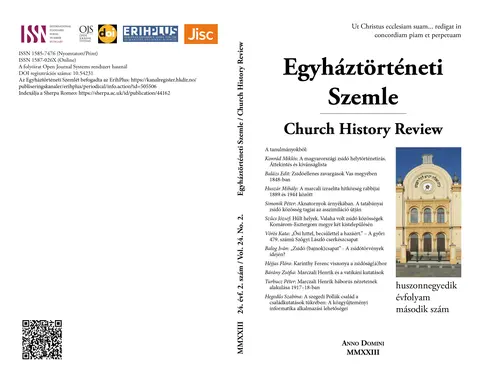
Ferenc Karinthy’s relationship with (his) Jewishness
DOI:
https://doi.org/10.54231/ETSZEMLE.2023.2.9Keywords:
personal history, journal, identity, Kádár eraAbstract
Ferenc Karinthy (1921–1992) was a linguist, novelist and playwright, but he also worked as a dramaturg in several theatres. Both in the Rákosi and the Kádár era, he created a great wealth of works, and thanks to immense energy, he left us many pieces – now little read. This may come as a surprise, since nowadays the name Karinthy is mostly associated with his father, Frigyes Karinthy. Besides his literary work, he also kept a private journal from 1967, where he recorded his thoughts all through until 1991. His journal was published in 1993, but by the 2000s it attracted little interest (with the exception of an attempt at compiling his oeuvre). Yet the journal is considered by many to be his major work. From his extensive journal (amounting to more than a thousand pages), which he kept for 24 years, we can get an idea of the course of his personal life, his search for identity, contemporary political issues, the everyday life of a writer, the intellectual dividedness of the Kádár era, his own insecurities, and – most importantly for the aspect of my field and this study – his relationship to Jewry.
Downloads
Downloads
Published
Conference Proceedings Volume
Section
Categories
License
Copyright (c) 2023 Héjjas Flóra (Szerző)

This work is licensed under a Creative Commons Attribution 4.0 International License.
The author(s) reserve the copyright of their work.
The Church History Review does not restrict the rights of authors to place their manuscripts or manuscript versions on preprint servers or other hosting. This applies generally to the following formats.
- Submitted version
- Accepted version (manuscript accepted by the author)
- Published version (Version of Record)