
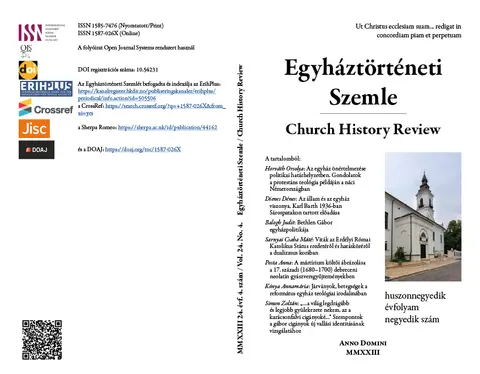
The self-concept of the Church in borderline political situations. Reflections on the example of Protestant theology in Nazi Germany
DOI:
https://doi.org/10.54231/ETSZEMLE.2023.4.156Keywords:
Bultmann, Bonhoeffer, the Church and the Jewish question, Protestantism in Nazi Germany, deification of the stateAbstract
In my study, I formulate three questions, which I approach through two public speeches that are contemporary theological reflections at a time of historical crisis in Germany in the spring of 1933: How does the Church relate to current political events? From a theological point of view, how can the concept of a borderline political situation be defined? What does the critical function of the Church mean? I will first put the speeches of Bonhoeffer and Bultmann into context, and then present a summary overview of the structure of their thought processes. The analysis concludes that both authors interpret the present as a confessional situation, the theological starting point of which is the deification of the state. It is within this framework that they both respond to the Aryan paragraph (Arierparagraph) and speak out not only on behalf of baptized Jews, but on behalf of all their fellow German Jews, regardless of religious affiliation. The essay points out the essential difference between their analyses of the situation in light of the possibility for activism.
Downloads
Downloads
Published
Conference Proceedings Volume
Section
Categories
License
Copyright (c) 2023 Horváth Orsolya (Szerző)

This work is licensed under a Creative Commons Attribution 4.0 International License.
The author(s) reserve the copyright of their work.
The Church History Review does not restrict the rights of authors to place their manuscripts or manuscript versions on preprint servers or other hosting. This applies generally to the following formats.
- Submitted version
- Accepted version (manuscript accepted by the author)
- Published version (Version of Record)