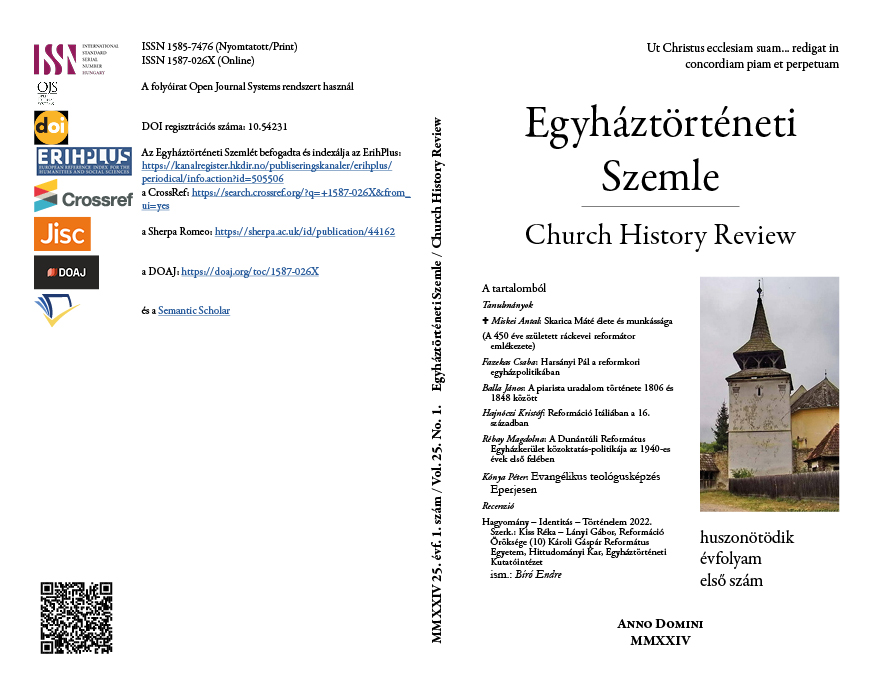
History of the Piarist estate between 1806 and 1848
DOI:
https://doi.org/10.54231/ETSZEMLE.2024.1.158Keywords:
piarist order, 19th century, economy, custodiatus, estate, reform era, 1848, feudalism, bourgeois transition, legal historyAbstract
At the beginning of the 19th century, Francis I donated the Piarist order, which was experiencing serious financial difficulties, one of the historically most significant estates in Hungary, the 50,000 acres of land that was owned by the Custodiatus of the Diocese of Székesfehérvár, established by King St. Stephen. Under the supervision of the friars, the estate provided the monastery with a steady income, which they could use to maintain the schools. However, the friars, who were slowly getting used to agricultural activity under the feudal system, had to face several difficulties until 1848: the Reform Diets were challenging the framework of the old economic order, and tried to re-regulate the relationship between landlords and serfs. In the meantime, a complex social, economic and political program was emerging among the reformist opposition, calling for the creation of a bourgeois Hungary. Although the Piarists kept up with the changes, the new situation created by the April Laws caught them unawares, which – for the order – raised uncertainties and several problems regarding the estate that seemed unsolvable.
Downloads
References
Downloads
Published
License

This work is licensed under a Creative Commons Attribution 4.0 International License.
The author(s) reserve the copyright of their work.
The Church History Review does not restrict the rights of authors to place their manuscripts or manuscript versions on preprint servers or other hosting. This applies generally to the following formats.
- Submitted version
- Accepted version (manuscript accepted by the author)
- Published version (Version of Record)